Grade 12 Mathematics Unit 4: Introduction to Linear Programming
About Course
Unit 4, “Introduction to Linear Programming,” introduces you to a powerful mathematical technique used for optimization in Grade 12 Mathematics. This unit focuses on how to make the best possible decisions given a set of constraints, a skill that is highly valuable in business, economics, and logistics.
Chapter 4.1 – Graphical Solutions of System of Linear Inequalities
This chapter builds the visual foundation for solving linear programming problems.
- Learn how to graph a system of linear inequalities on a coordinate plane.
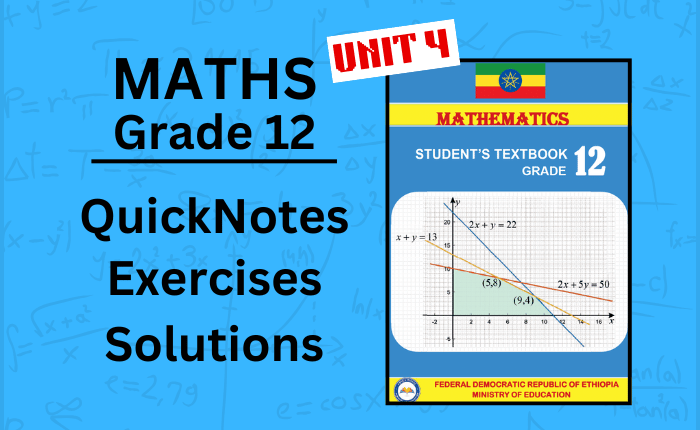
- Define the feasible region as the overlapping shaded area that represents all possible solutions satisfying every inequality in the system.
- Identify the vertices (corner points) of the feasible region. These points are critical for finding the optimal solution.
Chapter 4.2 – Maximum and Minimum Values
This section introduces the core method of linear programming for finding the best outcome.
- Define the key components of a linear programming problem:
- Objective Function: A linear equation representing the quantity you want to maximize (like profit) or minimize (like cost).
- Constraints: The system of linear inequalities that define the feasible region.
- Understand the Vertex Theorem (or Corner Point Principle), which states that the optimal solution (maximum or minimum) will always occur at one of the vertices of the feasible region.
- Learn the step-by-step process for solving:
- Graph the constraints to determine the feasible region and its vertices.
- Substitute the coordinates of each vertex into the objective function.
- Compare the results to identify the maximum or minimum value.
- Explore how to use spreadsheet software to efficiently organize and solve linear programming problems.
Chapter 4.3 – Applications
Apply your new skills to solve real-world optimization problems.
- Learn how to translate word problems into a mathematical model by defining variables, writing an objective function, and setting up the constraints.
- Solve practical problems in various fields:
- Business: Maximizing profit from producing different products with limited resources.
- Manufacturing: Minimizing the cost of production while meeting demand.
- Nutrition: Creating a diet plan that meets nutritional requirements at the lowest possible cost.
Learning Outcomes
By the end of this unit, you will be able to:
- Graph systems of linear inequalities and identify the solution regions.
- Construct linear programming models from given problems.
- Solve real-life problems using linear programming techniques.
- Apply the Vertex Theorem to find the maximum and minimum values of an objective function.
- Use spreadsheet software to solve linear programming problems.
Course Content
QuickNotes
-
QuickNotes – Grade 12 Mathematics Unit 4: Introduction to Linear Programming
Exercises
Textbooks
Student Ratings & Reviews

No Review Yet